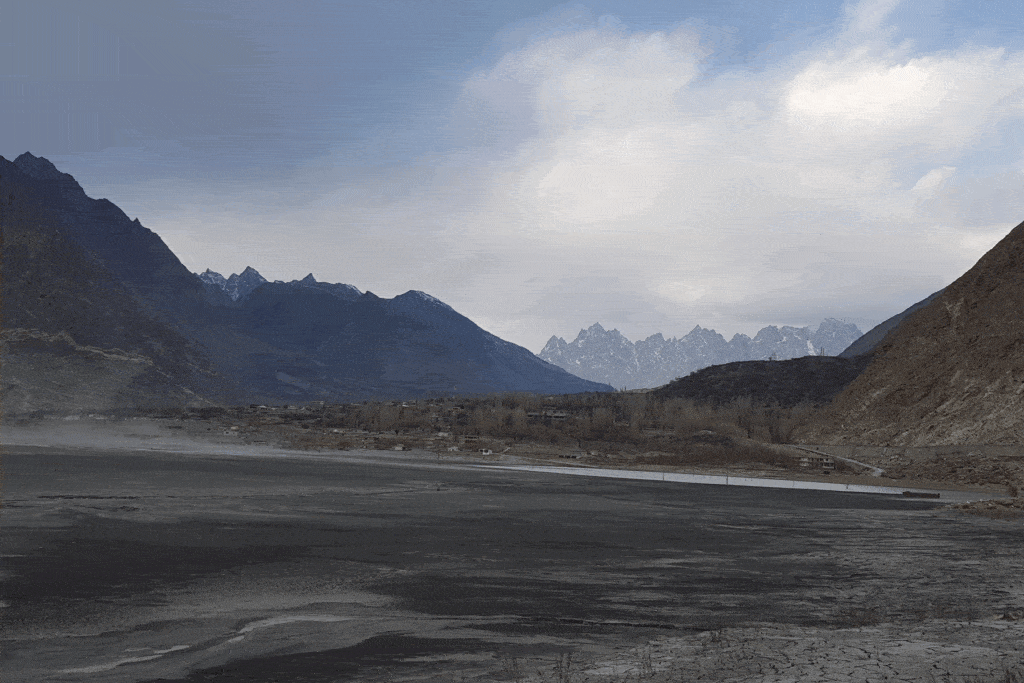
In the summer of 2016, Hunza, a mountainous district in Gilgit-Baltistan, Pakistan, experienced a surge of domestic tourists. Nadia Ali and Conrad Schetter‘s article in Political Geography explores the effects on the contested region through texts and extensive qualitative field research.
Abstract
This article conceptualises the notion of “tourism frontier” by examining tourism expansion in the Hunza district in Gilgit-Baltistan—a geopolitically contested territory within the India-Pakistan conflict over Kashmir. Drawing on frontier and critical tourism literature and informed by extensive qualitative field research—including participant observations, in-depth interviews, focus group discussions and policy analysis—this article develops a framework for understanding how tourism frontiers emerge and operate at state margins. The analysis identifies fundamental characteristics of tourism frontiers by examining the constellations of collaborative and conflictive interactions among state, market, and local actors. Findings reveal that tourism imaginaries construct remote landscapes as ‘pristine’ and their inhabitants as ‘hospitable,’ thus portraying them as available for commodification and accumulation. Such projections are reinforced by state-led infrastructure and economic initiatives, such as the China-Pakistan Economic Corridor (CPEC), which has positioned Hunza and the wider Gilgit-Baltistan as a ‘space of opportunity’ for investments, particularly in the tourism sector. Subsequently, within a deliberately maintained context of legal liminality and regulatory ambiguity—a state of ‘not-yet’—processes of commodification, territorialization, and privatisation unfold, enabling capital accumulation and state control. The frontier dynamics turn the tourist destination into a space of disenchantment—social and ecological ‘ruin’—for local inhabitants, whose social relations, livelihoods and ecology are sacrificed for external profit and power. Nevertheless, these impacts are actively contested. By conceptualising the tourism frontier, this article contributes to interdisciplinary dialogue across subfields of Political Geography and Tourism Geography. It offers an analytical tool for examining the tourism development in contested and marginalised regions.