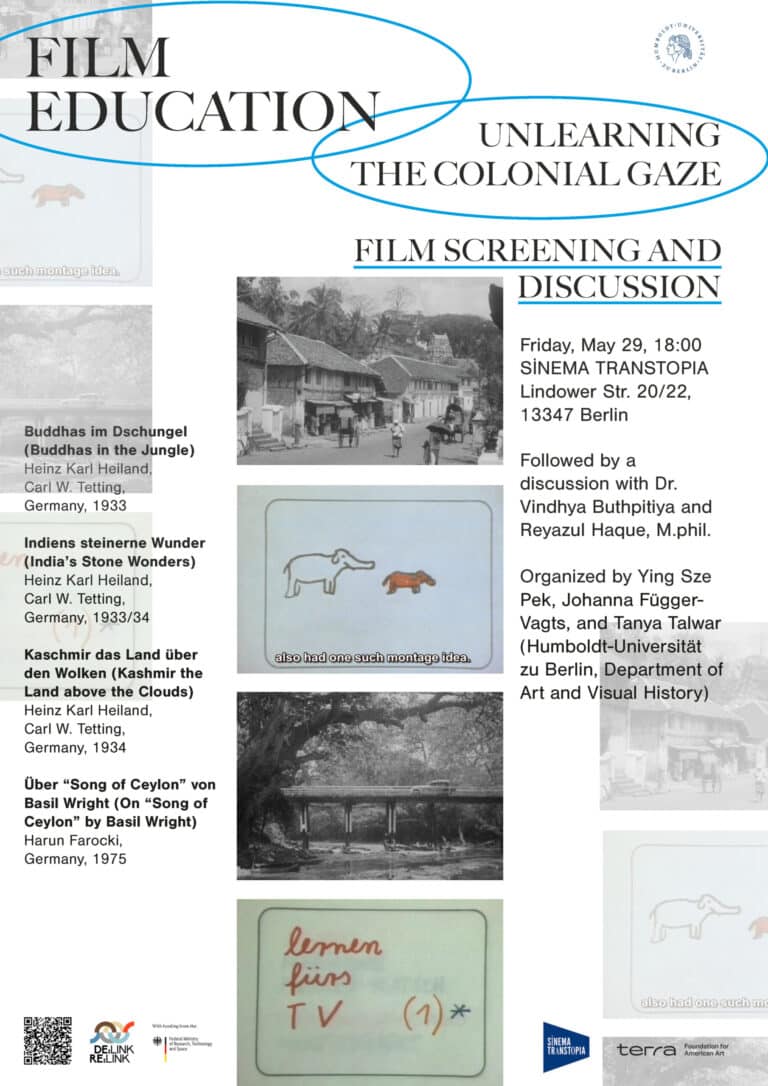
Film Screening at SİNEMA TRANSTOPIA, Berlin
Film Education: Unlearning the Colonial Gaze
18:00, 29 May 2026
Films:
Buddhas im Dschungel (Buddhas in the Jungle)
Heinz Karl Heiland, Carl W. Tetting, Germany, 1933, 12 min. German with English subtitles
Indiens steinerne Wunder (India’s Stone Wonders)
Heinz Karl Heiland, Carl W. Tetting, Germany, 1933/34, 11 min. German with English subtitles
Kaschmir das Land über den Wolken (Kashmir the Land above the Clouds)
Heinz Karl Heiland, Carl W. Tetting, Germany, 1934, 11 min. German with English subtitles
Über “Song of Ceylon” von Basil Wright (On “Song of Ceylon” by Basil Wright)
Harun Farocki, Germany, 1975, 25 min. German with English subtitles
Throughout the history of cinema, filmmakers across the political spectrum have engaged film’s pedagogical dimensions and potentials. As an educational medium par excellence, film has been used by government authorities, corporations, and practitioners alike to inform, persuade, and teach with—or even correct prior paradigms of filmic seeing. Learning through film may thus be didactic, experimental, authoritarian, or pleasurable.
Organized by researchers at Humboldt-Universität zu Berlin’s Department of Art and Visual History, this screening program brings together non-fiction films from two disparate episodes in German film history. Reflecting distinctive approaches to film and education, the program juxtaposes Lehrfilme of the 1930s with an instance of postwar political filmmaking that treats film as a pedagogical tool. First, we explore how a forgotten filmmaker deployed a primitivizing gaze to depict people, “cultures”, and places in South Asia as seemingly stable units of inquiry for a German audience in the 1930s. How did ideological and political perspectives during the period shape these representational tropes and techniques? The second half of the program examines a postwar German filmmaker’s engagement and appropriation of colonial film in their work. At the time of “the long 1968’s” cultural upheavals, how did experimental filmmakers deconstruct prior colonial visions in their pedagogically minded films, and address new mediums such as television?
The evening marks the German premiere of Buddhas im Dschungel, an ethnographic film digitized as part of the BMFTR research project De:link//Re:link by Murnau Stiftung, in consultation with Johanna Függer-Vagts and Tanya Talwar.
Following the screening, Vindhya Buthpitiya will provide insights and perspectives on the films’ portrayals of Sri Lanka.
Reyazul Haque is a film scholar whose research explores the connections between politics, temporality, and cinema. He recently curated and co-organised South Asian Cinema Week 2026 in Berlin as part of Subkontinent (Donaustr. 84), a space and host for critical South Asian conversations around films in Berlin. Apart from films, Reyazul has translated works by authors such as Arundhati Roy, Ngugi Wa Thiong’O, and Anand Teltumbde, among others.
Vindhya Buthpitiya is an anthropologist working at the intersection of conflict and visual culture. Her research is focused on resistance, ethno-nationalist conflict, and political violence in Sri Lanka, examining the local and global aftermaths of civil war through the making and moving of images. She is a lecturer in the Department of Social Anthropology at the University of St Andrews, Scotland and the author of “A Volatile Picture: War and the Political Work of Photography in Sri Lanka.”
Kindly supported by the Terra Foundation for American Art and the Chair for Modern Art History, Department of Art and Visual History, Humboldt-Universität zu Berlin. Film materials digitized with support from the BMFTR research consortium De:link//Re:link and Murnau Stiftung. Screening permission courtesy of Antje Ehmann and Harun Farocki GbR.