
There’s a myriad of media through which researchers can communicate their findings. And selecting the best way to pass on knowledge requires preparation and thought. In this vein, De:link//Re:link researchers Daniel Kossmann and Linda Ammann completed a training programme on science communication at the Technical University Berlin. The two podcasts produced during the programme provide some interesting insights into the motivation behind Daniel and Linda’s projects for our research consortium. These “TEL-Talks”, recorded by Alexandra Schulz and her team, present academic research to the general public in an entertaining and informative way.
Below is an edited excerpt from Daniel’s podcast, an interview that looks at how he chose his particular research project and conducted field work in Tanzania. The full interview, entitled “Narrativ-poetisch statt monoton”, is available (in German) on his website.
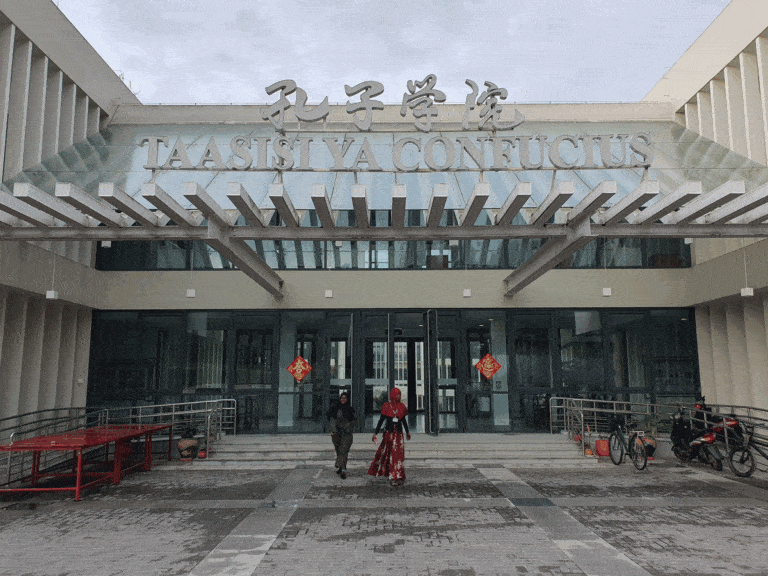
Alexandra Schulz: Could you give us a brief insight into your topic, your everyday work, what you actually do at De:link//Re:link? You are lucky enough to go on research trips from time to time. Maybe you could say a few words about what you do there, where you travel to and why.
Daniel Kossmann: As my colleague Linda Ammann mentioned, we are part of a research network called De:link//Re:link. I am employed at HU Berlin and conduct my own research on Confucius Institutes in Tanzania, specifically in Dar es Salaam, the largest city and metropolis in Tanzania. Confucius Institutes are Chinese language and culture institutes, and I am looking at how they have influenced the local art and culture scene. I compare them with other local cultural and art institutions as well as other international cultural institutions such as the Alliance Française, Goethe-Institut, and so on.
And were these countries that you selected set in stone? Or how did you decide on Tanzania?
I can only speak for myself. I come from the field of African Studies, which is a a subdiscipline of area studies, and in this field it is relatively typical to specialize in a particular region during one’s academic career, ideally in order to gain not only factual knowledge, but also a little bit of embodied knowledge about the region, contextual knowledge. That’s how the different areas of focus came about.
Over the last 10 to 12 years, I have lived in East Africa for almost three and a half years in total. I studied in Nairobi, Kenya, but I also did volunteer work there, did an internship in Rwanda, and I studied and took language courses in Tanzania. Originally, the plan was to compare Kenya and Tanzania, but for various reasons, that didn’t work out, so I ended up choosing Dar es Salaam, a city I know best, in Tanzania, a country whose language I also speak, Swahili [also known as Kiswahili].
Could you briefly explain how you came up with the idea in general? Did your studies make you think “I’ll go there” or did you have some other connection to it? Has Africa in general always fascinated you? How exactly did you get into this field?
I just find it really exciting. I think I’m part and a typical example of the weltwärts generation, meaning that after school I had a strong desire and interest to get as far away from Germany as possible, and at that point I didn’t really care where in the world that would be. It was just important to me that it wasn’t one of the typical countries like Australia or New Zealand. I applied to various countries and ended up in Kenya by chance, and that was such an eye-opener for me, having grown up in the German school system, in German society, with the corresponding stereotypes about Africa. I had those stereotypes in my head, and then I arrived in Nairobi and was confronted with them so strongly that it sparked a long-term interest or desire to engage with the region more deeply. I’m the kind of person who prefers to engage with one region more intensively than to skim the surface of many countries, which is why I kept going back to East Africa.
Maybe it’s a little off-topic, but I recently came across an old episode of the children’s TV series Bibi Blocksberg that no longer exists, as it’s been removed from the list. In it, the character Bibi Blocksberg travels to Africa, but there’s no further detail about where exactly she’s going. She just travels to Africa and that’s kind of it …
Well, I think the episode you’re talking about is probably representative of the German image of Africa, partly because Africa is somehow portrayed as a homogeneous mass, a homogeneous continent in the ideal case, but many people don’t even perceive it as a continent at first, just a homogeneous continuum. There are still a lot of stereotypes about it, even today. And that’s probably also the strength of the fields I come from, because when you keep going back to a region and try to learn the language, then ideally the outcome – and we’re probably already talking about science communication here – is that you can bring back a different image of that region to the dominant culture you come from.
You just mentioned language again. You said you speak Swahili yourself. Was it difficult to learn? How different it is from German?
I would say that it is relatively easy for people with a German-speaking background to learn Swahili, purely in terms of pronunciation. I’m not entirely sure, but I think it also has to do with the fact that the language was originally written in Arabic script and then, through missionary work, it was eventually written in Latin script. And it was a German missionary, Johann Ludwig Krapf, among others, who implemented this. I suspect that’s why it’s easier for German speakers to pronounce. I don’t want to swear to it, but that’s my guess.
Grammatically, it’s a different system. It works a lot with noun classes. I think that would be too complicated to explain right now. But the advantage is that even if you don’t have a perfect command of the grammar and speak the language relatively crudely, people still understand you. So I would say it’s relatively easy to acquire a basic knowledge. But then, speaking like a native speaker, or first-language speaker, is actually quite difficult. I mean, reaching a really high level so that you can read novels, for example, or poetry or something like that. That’s quite something, being able to speak in such a way that people can no longer tell. That takes a while.

For our certificate programme, you designed and gave a presentation for that dealt with some insights from one of your trips to Tanzania. Your talk was based on a photo. Could you tell us a little bit about what kind of photo it is, how it came about, and why you found it so exciting.
In the presentation, I talked in a very narrative way, because I deliberately decided against the typical academic format, in which you don’t use so much emotion and perhaps also use very dry language. I decided against that in order to take people along with me on my experiences. And yes, I talked about the photo and explained that it’s very representative of the cultural work of the Confucius Institute in Dar es Salaam, since my research has shown that the institute focuses primarily on language teaching. That’s what Tanzanians are most interested in, unlike the Alliance Française or the Goethe Institute, which combine language teaching with cultural mediation. So there are cultural events, there are kung fu classes, there are tai chi classes, there is also this movie club, but it is not advertised very much. These cultural events are more for a closed audience, for students from the university, but aren’t promoted to the general public. And I think this photo symbolized that perfectly.
The photo is a simple one, a snapshot. I took it by chance with my mobile phone. I spent four months in Dar es Salaam doing field research, and I spent a lot of time at the Confucius Institute itself, which is located directly at the University of Dar es Salaam. I conducted interviews with members of staff, but I also participated in language classes, as a form of participant observation. At some point, I was walking through the institute and saw a note attached to a door, scribbled down relatively quickly, with the words “Movie Club” written on it.
One of my research questions was, how does the Confucius Institute actually influence the local cultural scene, and what kind of cultural offerings does the Confucius Institute itself provide? Almost no one had mentioned this movie club in the interviews up to that point. This naturally piqued my interest: okay, there’s a movie club here, what is that? It was a small piece of paper that you could only see when you walked past. Students are definitely aware of this club. But it wasn’t a designed poster, it wasn’t widely shared on social media. I think that’s why it’s such a good parable, a good symbol. That’s why I found it so exciting and decided to include it in the talk.
Why are the Confucius Institute’s cultural activities promoted in such a limited way? Why are they advertised to those participating in language or sports courses, but not to the outside world?
I can’t say that I know. What I do know is what my interviews have shown, which is that the greatest interest is simply in language, language, language, because many students hope to find jobs by learning Standard Chinese. Many of the students either have another degree programme they are following on the side or are doing this as their major. I think there’s just not that much interest in studying culture as well. At the same time, the university campus in Dar es Salaam is located a bit outside the city. It might be easy for students to get to, but as the city has 8, 9, or 10 million inhabitants, not everyone has easy access to it.
Maybe it is related to the fact that European cultural institutes are still struggling much more with their role in the past: Germany was a colonial power in Tanzania; France wasn’t powerful there, but we know of course that it was in other countries, particularly in West Africa. This colonial baggage could play a major part in why their cultural institutes aim to make themselves more visible now. In my interviews it sometimes came up that the European cultural institutes aimed to make their programmes more prominent in order to show people that they are more than just former colonists. In a certain way cultural institutes are always an extension of foreign policy. In contrast, China was not a colonial power in Tanzania, so it doesn’t have to contend with that legacy.
In the end, though, I think the most important factor really is work – Tanzanian people’s interest in finding work [through learning the language].
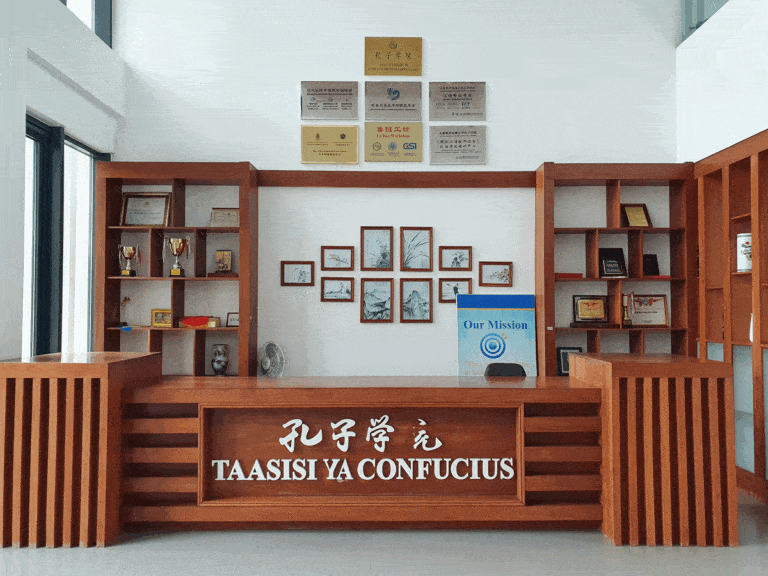
Chinese companies are definitely investing more heavily in Tanzania than German or most European companies, I think. That’s why so many jobs are being created there. And for Chinese companies, it’s also good, of course, when there are local workers who can speak Standard Chinese, with whom they can communicate directly, or who are good at Standard Chinese but also fluent in Swahili and English and can then act as translators. So, of course, it’s of interest and beneficial to both sides.
One could have thought about it and said, okay, English as, let’s say, the universal language of communication alone could be the door opener. But it’s exciting that, despite this, learning Standard Chinese is obviously still a skill that may be in high demand.
I think so. There is also the fact that many students will or would like to study in China, which is another major factor. That makes it all the more important. But I think, yes, Standard Chinese will probably soon play a role similar to that of English today. I say this as a non-sinologist. That’s just my assessment.