
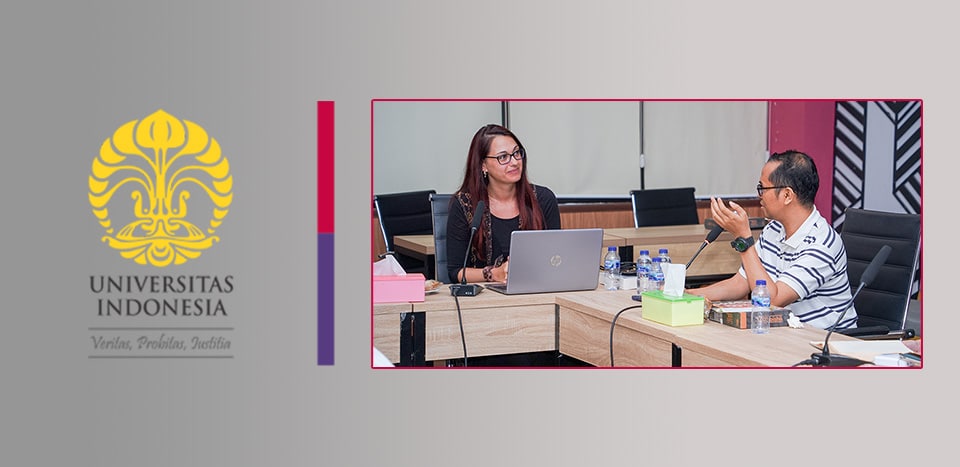
On August 13th 2026, the Policy, Governance, and Administrative Reform Research Cluster at the Faculty of Administrative Sciences, Universitas Indonesia (UI), held its 5th Brown Bag Discussion, addressing the topic “Beyond the Western Paradigm: How Indonesia Navigates China’s BRI & Asymmetric Policy Capabilities.” The event featured Dr. Amanda tho Seeth, research associate and lecturer in Transregional Southeast Asian Studies at Humboldt-Universität zu Berlin and cooperation partner at De:Link//Re:Link, as a speaker.
This interactive, bilingual, and interdisciplinary discussion was attended by academics from diverse disciplines at Universitas Indonesia, including the Chair of the UI Board of Professors, Prof. Dr. Eko Prasojo, Professor of Business Administration, Prof. Dr. Martani Huseini, Public Administration lecturers Dr. Defny Holidin and Dr. Desy Hariyati as well as Prof. Dr. Aditya Perdana from the Department of Political Science. The event also drew over a dozen in-person participants and dozens more joining online.
In her talk, Dr. tho Seeth introduced the bottom-up approach and culture-focused perspective of the De:Link//Re:Link research consortium to the Indonesian colleagues. She highlighted how transregional outlooks based in New Area Studies may uncover the accompanying cultural dimensions of economic and political projects such as China’s BRI. Her presentation focused on her ongoing research on how the BRI is reshaping the Indonesian Islamic infrastructure – for instance, mosques and Islamic education institutes (pesantren [Islamic ‘boarding schools’] as well as Islamic campuses) – and sketched a planned publication project in collaboration with her Berlin-based colleague Ariff Hafizi Radzi, who works on the same question for the Malaysian context. The comparative paper will carve out similarities and differences in how the BRI affects Muslim life in both countries and will explain the differences through a comparative-historical analysis.
In the Indonesian case, as Dr. tho Seeth elaborated, it is particularly Mandarin language training and scholarship programs for Muslims to study in China that have entered the Indonesian Islamic ecosphere. China is thus appearing as a new actor within the Indonesian Islamic milieu, particularly within the Indonesian Islamic education system and Islamic mass organizations like Nahdlatul Ulama and Muhammadiyah. Hence, through the BRI, China is competing with long-established foreign actors such as Egypt, Saudi Arabia, Iran, the US, Canada, and the Netherlands, over alliance-building with Indonesian Muslims. These new dynamics within the Indonesian Islamic infrastructure are unfolding against the backdrop of an Indonesian history of deep-seated anti-Sinicism and anti-Communism on the one hand, and anti-Muslim discrimination in China (the Uyghur issue), on the other hand. Dr. tho Seeth concluded that much of the way in which Indonesia navigates the BRI can be explained by the country’s foreign policy motto bebas aktif (free and active), the international environment of a rising Global South, and Indonesia’s ongoing attempts to mitigate Western influences within its own terrain. Furthermore, she argued that a re-narration of Indonesian Islamic historiography is currently taking place, which is increasingly appreciating the Chinese influence on Islamization in the country. Academic and public discourse in Indonesia is showing greater acknowledgment of the legendary Chinese Muslim admiral Zheng He and the Chinese background of several Wali Songo, the missionaries who contributed to the spread of a localized Islam in 15th-century Java.
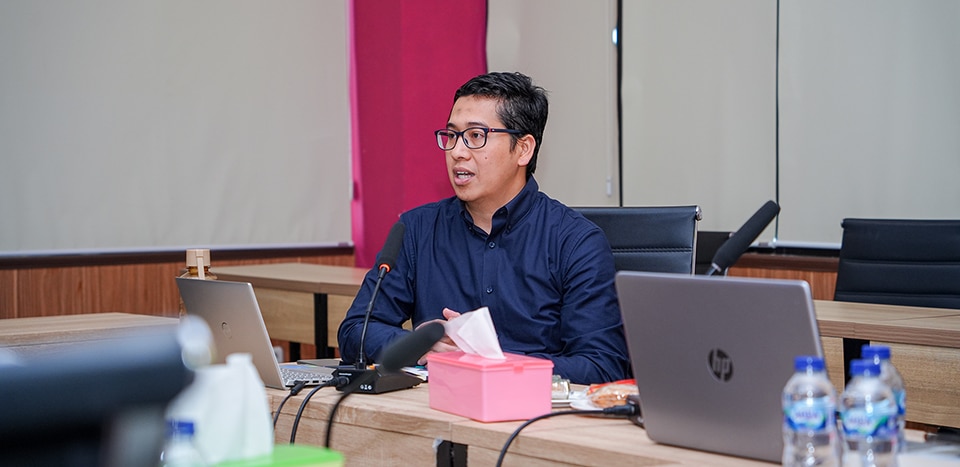
The second speaker at the Brown Bag Discussion was Dr. Defny Holidin, UI’s public policy expert. He presented a critical perspective on the asymmetry of power that typically characterizes foreign-funded development projects, such as the BRI. He introduced several examples to showcase how Indonesia is striving to fulfill the overarching objectives of the BRI at the expense of good governance standards within its own borders, especially at the local level. While Western development assistance schemes usually demand a commitment to democratization and the protection of human rights from recipient countries, China-based developmentalism comes without conditionalities and requirements for institutional reform. Instead, a pragmatic and accelerated implementation of infrastructure projects is preferred by the Chinese side, which often leads to the bypassing of Indonesian bureaucratic regulations and processes, thereby contributing to corruption at the local level and environmental deterioration. By problematizing different dimensions of the BRI in Indonesia, the talks by Dr. tho Seeth and Dr. Holidin complemented each other and were followed by a lively discussion on the relationship between China and Indonesia by the on-site and online participants.
A report in Indonesian is available on UI’s website.