
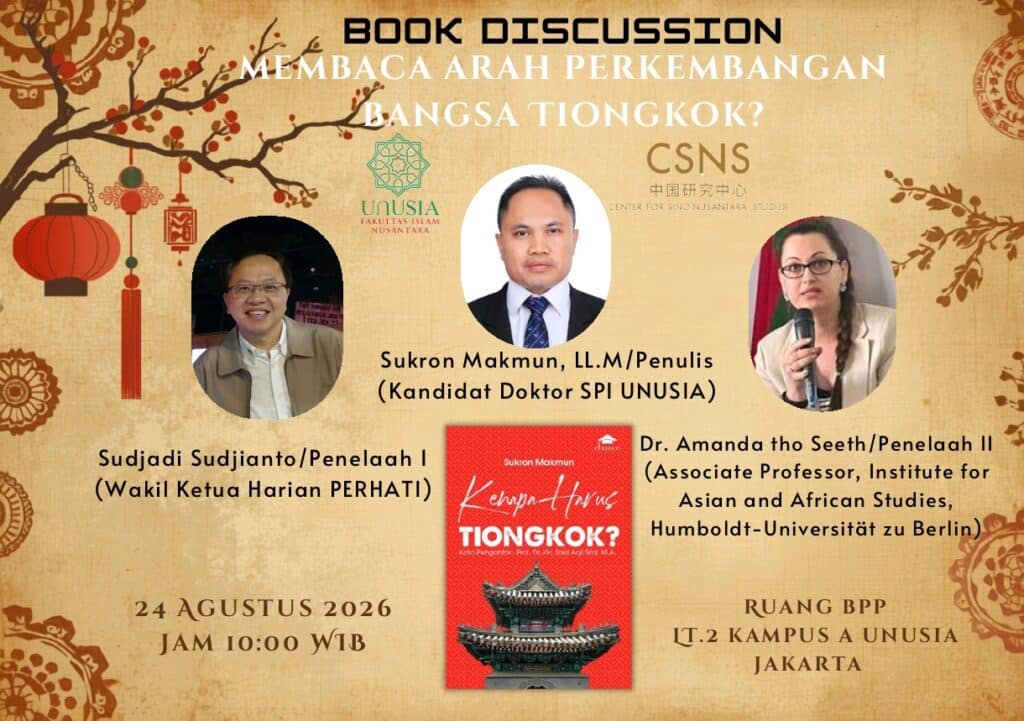
On August 24, 2026, the newly established Center for Sino-Nusantara Studies at the Nahdlatul Ulama University of Indonesia (UNUSIA), a private Islamic university affiliated with the nationally influential Islamic civil society organization Nahdlatul Ulama, held a book talk in Indonesian on the recently published Kenapa Harus Tiongkok? (Why Must It Be China?) by author Sukron Makmun, a young intellectual and active member of Nahdlatul Ulama. A dozen UNUSIA staff members were present and shared their perspectives on the relationship between Indonesia and China. Dr. Amanda tho Seeth, research associate and lecturer in Transregional Southeast Asian Studies at Humboldt-Universität zu Berlin and cooperation partner in the De:link//Re:link project, was invited to serve as commentator. In her remarks, she contextualized the book’s content within the broader landscape of Indonesian discourse on China, presented preliminary findings from her own research on Chinese interactions with Indonesian Islamic infrastructure (Islamic educational institutes, mosques, civil society organizations), and critically questioned China’s rising presence beyond its own borders.
The book talk was exemplary of the growing visibility of China-themed books on the Indonesian publishing market and of the increasing engagement of Indonesian Muslim circles with China and Chinese culture and language. China’s strong presence in Indonesia through the Belt and Road Initiative and its intensified soft-power diplomacy is also reflected in the work of other Indonesian authors. A stroll through Indonesia’s largest bookstore chain, Gramedia, across Java shows that entire shelves are now filled with new publications on China-related topics that tend to present the country and Chinese civilization in a positive light. Many of these publications share common lines of argument and a sympathetic view of China—characteristics which are also reflected in the book discussed here. Indonesian publications on China since 2013 therefore offer a rich entry point into Indonesian narratives about the People’s Republic. Dr. tho Seeth is accordingly prepared to bring home a range of recent books for further analysis in the context of the De:link//Re:link research project.
The book under discussion, Why Must It Be China?, was published in 2025 by Perkumpulan Persahabatan Alumni Tiongkok Indonesia (Indonesian-Chinese Alumni Friendship Association, PERHATI), an organization based in Jakarta. The publishing house represents Indonesian alumni who have studied in China and aims to strengthen relations between the two countries. The book includes a foreword by Said Aqil Siraj, who served as chairman of Nahdlatul Ulama from 2010 to 2021, which showcases the organization’s strong engagement with China. The book’s author, Sukron Makmun, is currently a PhD candidate working on the history of Islamic civilization at UNUSIA; he is known as an analyst of international geopolitics for Indonesian media outlets and the Ministry of Foreign Affairs. Although Makmun has not studied in the People’s Republic, he served as a representative of PERHATI from 2019 to 2022 and has undertaken dozens of trips to China, accompanying official Indonesian delegations and living and preaching in Hong Kong and Macau.
Similar to the majority of recent Indonesian publications on China, Makmun’s book conveys a highly positive image of China and argues that Indonesia would miss a major opportunity if it failed to engage in a close partnership with the country. On the opening pages of the book, the famous predicate attributed to the Prophet Muhammad, “Seek knowledge even if you have to go as far as China,” is quoted. Accordingly, China is presented as a place of knowledge and as a role model for innovation, development, and modernity. This positive image is frequently juxtaposed with “the West,” and particularly with the exploitation and suppression during European colonialism. In contrast to China, “the West” is not presented as a model to be followed in pursuing development and modernity. As is frequently emphasized in Indonesian public discourse on economic development and social equality, the author highlights that, over the relatively short period of forty years, China succeeded in lifting a large part of its population out of extreme poverty. From an Indonesian perspective, this fact alone makes China stand out in global comparison, and supports its role as a model for other countries of the Global South.
Almost all Indonesian authors writing about China are confronted with the “Uyghur issue”, and many opt to portray the political situation of Muslims in Xinjiang in ways that are rather favorable to the Chinese government. Makmun does so as well, following the common argument that Chinese authorities are implementing development policies in Xinjiang that are not directed against Islam as a religion or against Islamic culture, but rather aim to improve people’s living standard in the region. Like other authors, Makmun also emphasizes the peaceful relationship between the Hui Muslim population and the Chinese state. Dr. tho Seeth introduced a more critical perspective on China, drawing attention to the government’s strategic weakening of political opposition forces and the country’s low level of human-rights protection. She also asked whether the perspective on China-Indonesia relations could be reversed in order to identify Indonesian experiences and cultural assets from which China might learn—for instance, how to democratize a highly pluralistic society. Interestingly, Sukron devotes an entire chapter to conventional Indonesian misconceptions about China. His discussion focuses on Indonesian hostility towards communism as an allegedly atheist ideology, which, he argues, is not necessarily justified. As Dr. tho Seeth added in her remarks, Indonesian history itself demonstrates that a number of national key figures brought Islam and communism or socialism into close dialogue, including Tjokroaminoto, Tan Malaka, Sukarno, and Gus Dur.
In sum, the author’s generous attitude towards China is representative of a growing generation of Indonesian Muslims who orientate themselves towards China for education and business opportunities, while “the West” is becoming less attractive in their eyes. Whereas their parents’ generation tended to be influenced by the state-led rhetoric of anti-Sinicism and anti-communism under president Suharto’s authoritarian “New Order” regime (Orde Baru, 1966–1998), the tide is now turning towards a greater appreciation of Chinese civilization as well as the achievements of Indonesia’s ethnic Chinese minority for national development. This also includes renewed attention to the role of ethnic Chinese actors in the spread of Islam throughout the Indonesian archipelago. Furthermore, against the backdrop of growing criticism of Western geopolitics and the economic rise of the Global South, including the BRICS+- countries, China has gained a reputation as the center of a new Asian future and a new form of modernity.
It is particularly a narrative of a forgotten Islamic history that China and Indonesia share and that needs to be rediscovered. The topic is currently gaining prominence in Indonesian Muslim academic and public debates—a trend that is also manifested in the establishment of new institutions such as the Center for Sino-Nusantara Studies at the UNUSIA campus, which is dedicated to researching and fostering relations between the two countries. On the occasion of the center’s opening in December 2025, the university’s academic journal, Islam Nusantara: Journal for the Study of Islamic History and Culture, published a special issue entitled “Historical Trajectories of Sino-Nusantara Relations” (Issue 1/2026), covering a diverse range of topics, from early Islamic encounters to culinary exchanges.
Overall, the book talk brought together different perspectives on China: Indonesian Muslim elite perspectives that tend to be more favorable towards China, and the more critical interventions of Dr. tho Seeth. Both sides, however, shared the view that Islam and communism need not necessarily be mutually exclusive, and that certain forms of synthesis are possible, as demonstrated by Indonesian historical experience. Furthermore, the discussion highlighted the importance of book publications as sources for analyzing nation-specific narratives about foreign countries and bilateral relations—an aspect that merits further investigation in future research.