Audio Feature: Linda Ammann on Graphic Recording
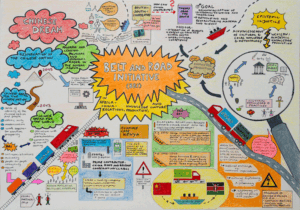
Complex ideas are sometimes better communicated visually. In this podcast, Linda Ammann describes how she employed graphic recording to describe and connect elements of her research.

Complex ideas are sometimes better communicated visually. In this podcast, Linda Ammann describes how she employed graphic recording to describe and connect elements of her research.

Since the De:link//Re:link research consortium formed in April 2021, there have been dramatic political changes in (Eur)Asia. During our second phase of funding, we’ve adjusted our focus to cover major shifts across the globe.

Entitled “New Insights about the BRI from (Eur)Asia to (East)Africa: Strategies, Narratives and Reactions”, the event brought together scholars from all four of De:link//Re:link’s research consortium partners. Intensive discussions were followed by presentations for the ZOiS Forum.

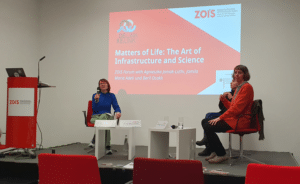
The exhibition “Indigo Waves and Other Stories: Re-Navigating the Afrasian Sea and Notions of Diaspora” took place at Gropius Bau and SAVVYContemporary, Berlin, from April to August 2023. John Njenga Karugia presented his work there in a session chaired by Hajra Haider Karrar.

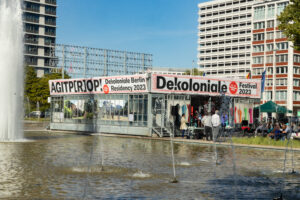
In September 2023 the Dekoloniale Festival looked at transnational Afro-Asian connective memories in Berlin, Germany and Bandung, Indonesia. John Njenga Karugia attended the exhibition, walking tour, and international conference.

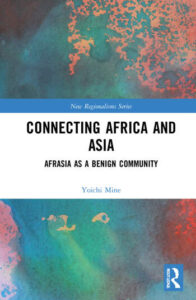
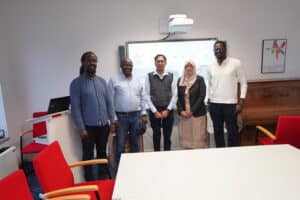
As part of my visit to Berlin (this past September 2023) to do some work on the De:Link // Re:Link Project involving the Belt and Road Initiative, I had the opportunity (among many other activities such as the pleasant trip to the port of Duisburg, the largest inland port in the world) to read and discuss with some members of the project team, during the De:Link // Re:Link Silk Roads Roundtable, a new book on Africa and Asia by Professor Yoichi Mine of the University of Tokyo.

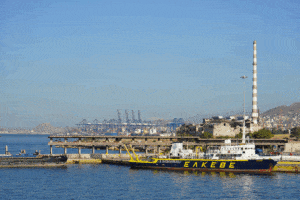
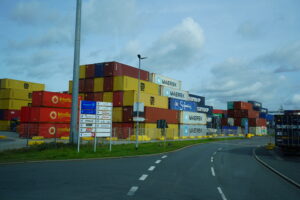
Unknown to many, Duisburg Port in Germany is the largest inland port in the world and the most significant inland port in central Europe. It consists of 22 port basins and its waters cover an area of 180 hectares. Approximately 60 freight trains travel weekly from Duisburg to Chongqing city in China and vice versa, making the Duisburg Port a key hub of the Belt and Road Initiative (BRI). At Duisburg Port, 20,000 ships and 25,000 freight trains

How might it be possible to integrate the results of research on the BRI into education on globalisation? A workshop for teachers, organised by Ulrike Cordier and John Njenga Karugia, addressed this theme and others in late 2023.

During the summer and winter semesters of 2023, we hosted four research fellows. In order for them to share their work with our network, we hosted a Silk Roads Roundtable session. They shared their diverse approaches to researching the multifacted BRI.

We would like to announce the recently published book chapter titled: “Electrification of Forest Biomes: Xingu-Rio Lines, Chinese Presence, and the Sociotechnological Impact of the Belo Monte Hydroelectric Dam” by De:link//Re:link associated fellow Prof. Dr. Diego d’ Ávila Magalhães (Federal University of Goiás) and his colleagues Laís Forti Thomaz and Aline Regina Alves Martins. The chapter is